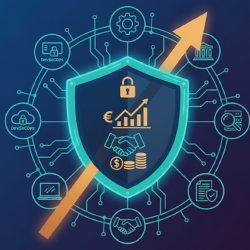
In a competitive market, a modern security architecture demonstrates operational maturity and drastically reduces the time and friction of Investor Due Diligence.
The challenge for Europe’s high-growth Tech SMEs is greater than securing the perimeter; it’s about architecting security into the business model itself.
Forward-thinking leaders recognize that a robust security framework is a great competitive advantage for scaling and a prerequisite for greater chances of securing investment capital.
Our below analysis outlines three core areas where security must be engineered for scale, turning your technology stack and operations into your competitive advantage investment pitch.
1. Engineer Security into the Development Process (DevSecOps)
The speed of innovation cannot be sacrificed for security, nor can security be an afterthought.
Integrating security tools and practices seamlessly into the development lifecycle (DevSecOps) ensures vulnerabilities are uncovered and addressed at different stages of the software development and deployment, preventing costly delays and rework later.
The ‘Shift Left’ approach means implementing security practices at design and development phases, crucial for sustainable product velocity.
| Focus Area | Strategic Actions |
|---|---|
| Shift-Left Security | Implement automated security testing (SAST/DAST) early and often within the CI/CD pipeline. Security must be a part of the code commit and build, not just the final deployment. |
| Infrastructure as Code (IaC) Hardening | Utilize IaC tools (e.g., Terraform) to provision infrastructure with security settings, compliance standards, and access controls built-in from the start, minimizing manual configuration drifts and errors. |
| Threat Modeling | Integrate threat modeling into the design phase of new features or products. Proactively identify potential risks before coding begins for greater impact, saving significant remediation costs. |
2. Modernize Access with a Zero Trust Architecture
The shift to remote work and cloud services has rendered traditional network perimeters obsolete.
Zero Trust is a security model based on the principle of “never trust, always verify.” It assumes no user or device, even those inside the network, should be trusted by default, drastically minimizing the impact of unauthorized access.
| Focus Area | Strategic Actions |
|---|---|
| Conditional Access Policies | Implement policies that require continuous verification based on user role, device health, location, and the sensitivity of the data being accessed. |
| Micro-segmentation | Isolate network resources into small segments to limit lateral movement. If a breach occurs, micro-segmentation ensures the threat can be contained within a small zone. |
| Phishing-Resistant MFA Deployment | Move beyond standard time-based MFA (TOTP) to implement phishing-resistant methods (e.g., FIDO2 keys) across all core enterprise and cloud systems. |
3. Translate Security Maturity into Investment Readiness
For high-growth SMEs, the security review during Due Diligence (DD) can make or break a funding round or acquisition.
A pre-planned, auditable security posture transforms the DD process from an obstacle into a demonstration of operational excellence.
| Focus Area | Strategic Actions |
|---|---|
| Standardized Reporting | Adopt standardized security frameworks (e.g., ISO 27001 or SOC 2). This provides investors with an immediate, recognized metric for your security maturity and risk profile. |
| Evidence Collection for Due Diligence | Maintain a centralized, auditable repository of security controls, incident response plans, vulnerability management data, and compliance documentation, ready for instant investor review. |
| Dedicated Security Leadership | Assign clear accountability for security at the executive level (e.g., a vCISO or dedicated CISO). Investors invest in management teams that take security governance seriously. |
Conclusion: Security as a Growth Enabler
Security by Architecture is the cost-effective path to scalable growth.
By embedding security into your development, access, and governance models, you are meeting compliance and are building a future-proof technological competitive advantage that minimizes operational friction, protects intellectual property, and significantly accelerates investor confidence and valuation.
Discover how our strategic CISO services can help you architect a security posture that enables hyper-growth and prepares you for your next capital event.
Contact us to discuss optimizing your technology stack for security and scale.