In the 2026 landscape, the obsession with “Time-to-Market” has become the primary driver of structural fragility.
The challenge for the 2026 C-Suite is not how to slow down, but how to maintain velocity without compromising structural integrity.
True market leaders don’t just ship faster; they build systems designed to retain their value despite regulatory friction, technical stress, or geopolitical shifts.
This analysis deconstructs the three hidden debt vectors that are currently eroding corporate valuations across the European tech sector.
1. The Speed Fallacy and Structural Decay
Speed is a liability when direction is unverified.
When teams optimize for deployment frequency without a parallel mandate for Architectural Resilience, they aren’t scaling an asset; they are financing a slow-motion catastrophe.
| Risk Factor | Diagnostic Verdict |
|---|---|
| Invisible Decay | Modern stacks are so interconnected that traditional monitoring is obsolete. Automated deployments without a Hardened Governance Layer result in a total loss of auditability and control. |
| Fiduciary Debt | In a due diligence scenario, lack of architectural control is an unquantifiable liability that can be directly priced into your firm’s valuation. |
2. The European Sovereignty Dilemma
Performance without sovereignty is a hidden debt.
The friction between high-performance global software and rigid EU Digital Sovereignty mandates is creating a ‘sovereignty gap’ in the boardroom.
| Strategic Pivot | Mandatory Action |
|---|---|
| Jurisdictional Control | Sovereignty is no longer a political statement; it is a fiduciary requirement. In a high-stakes exit or funding round, unaddressed extra-territorial legal exposures (like the US CLOUD Act) can become friction points that complicate your cap table. |
| Operational Autonomy | Prioritize autonomy for business-critical operations. Avoid vendor lock-in that limits your agility to pivot when international regulatory climates shift. |
3. AI Acceleration vs. Governance Sanitization
Innovation without oversight is a paradox. Many firms are deploying tools today that they may not fully control tomorrow.
Generative AI without a Governance Architecture is not a technical glitch; it is a fracture in your fiduciary accountability.
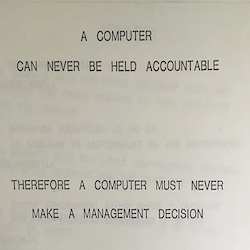
The 1979 IBM mandate featured in our cover remains the gold standard that the modern C-Suite ignores.
Regulators will not accept “AI hallucination” as a defense for systemic compliance failures.
A computer can never be held accountable. Therefore, a computer must never make a management decision. — IBM, 1979.
| Focus Area | Diagnostic Reality |
|---|---|
| The Liability Gap | Regulators will not penalize the algorithm; they will penalize you for negligence. Under the EU regulatory framework, penalties of up to 6% of global turnover are a reality for systemic failures. |
| IP Devaluation | Unauthorized training data and model exfiltration lead directly to the devaluation of your competitive moat. Treat your key ML models and Prompts as Crown Jewels. |
Conclusion: Stop Trading Valuation for Short-term Metrics
True resilience is not the absence of failure; it is the absolute sovereignty over your recovery.
The Board must stop asking “How fast can we ship?” and start demanding “How fast can we recover?”. Resilience then becomes the ultimate force multiplier.
At Argorex, we engineer the momentum that allows you to scale with confidence. We ensure your innovation builds equity, transforming technical governance from a cost center into a valuation driver.
Does your current architecture survive a regulatory audit? Contact us for a structural diagnosis.